Medical Billing Audit Services That Recover Lost Revenue & Protect Your Practice
Most practices lose 5%–15% of annual revenue to billing errors, denied claims, and underpayments without ever knowing it. Our professional medical billing audit service identifies every dollar you’re losing and gives you a clear plan to recover it.
UNDERSTANDING THE BASICS
What Is Medical Billing Audit?
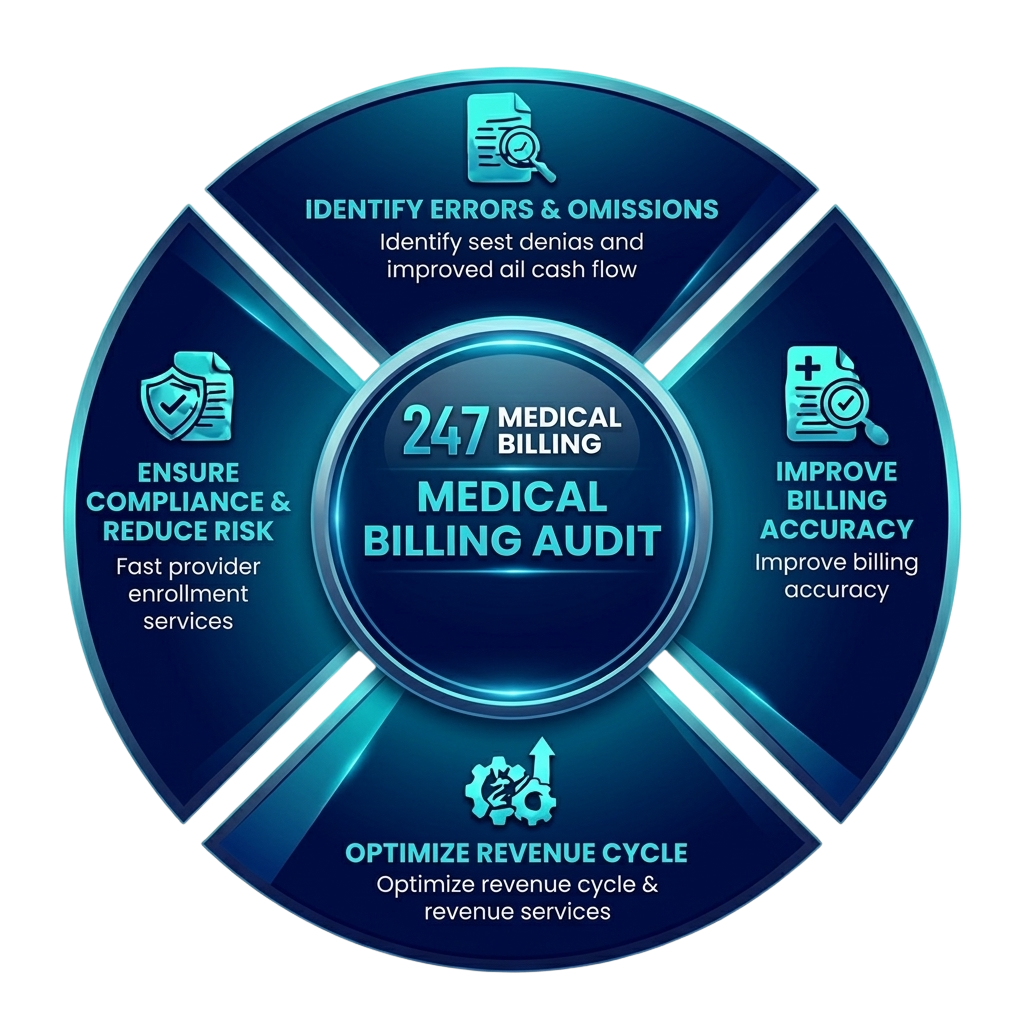
A medical billing audit is a systematic, independent review of your practice’s claims submissions, coding accuracy, payer payments, compliance posture, and revenue cycle workflows designed to find money you’ve earned but haven’t collected.
A thorough billing audit examines every stage of your revenue cycle from patient registration and charge capture, all the way through to payment posting and accounts receivable follow-up.
The goal is simple: identify where your practice is leaking revenue, fix the root causes, and recover what you’re owed.
WHAT A BILLING AUDIT COVERS
A Medial Billing Audit Examines:
CPT, ICD-10, and HCPCS coding accuracy across all claim types
Claim submission errors, duplicates, and timely filing violations
Payer contract compliance and underpayment detection
Denial patterns, root causes, and appeal opportunities
HIPAA compliance and OIG billing risk assessment
Revenue cycle workflow gaps and front-desk process errors
Documentation adequacy and medical necessity support
Missed charges, unbilled services, and modifier errors
Prior authorization compliance and coordination of benefits
Benchmark comparison against MGMA industry standards
UNDERSTANDING THE BASICS
Why Medical Billing Audits Are
No Longer Optional
The Medical Group Management Association (MGMA) and industry-wide data paint a
clear picture: billing errors are universal, and most practices aren’t catching them.
5-10%
Average claim denial rate for most medical practices(MGMA)
80%
Medical claims that contain at least one billing error
$125B
Lost annually to billing errors and uncollected claims
65%
Of denied claims are never resubmitted, revenue permanently lost
Sources: Medical Group Management Association (MGMA) – American Medical Association (AMA) – CMS OIG Annual Report
6 Revenue Leaks A Medical Billing Audit Detects And Fixes
Most revenue loss is quiet. These are the six most common and most costly problems a professional billing audit uncovers in healthcare practices of every size and specialty.
Revenue Leakage & Undercoding
Undercoding billing for a lower E/M level than documented and missed charges are the most silent forms of revenue loss. A billing audit identifies every instance where your practice billed less than it was entitled to.
Denied Claims Left Uncollected
Insurance payers deny claims for dozens of reasons: missing prior auth, eligibility errors, coding mistakes, and timely filing violations. Without a structured denial management process, these dollars disappear permanently.
CPT, ICD-10 & Modifier Coding Errors
Incorrect CPT codes, mismatched ICD-10 diagnosis codes, missing modifiers, and unbundling errors cause denials, underpayments, and in serious cases, compliance violations. Coding audits catch these before payers do.
Billing Compliance & Regulatory Risk
The OIG and CMS actively monitor for upcoding, unbundling, and medically unnecessary billing. A compliance-focused billing audit identifies your risk exposure and corrects it before it triggers a payer or government audit.
Payer Underpayments & Contract Violations
Insurance companies sometimes pay less than your contracted fee schedule requires. Without systematic payment variance analysis, these underpayments go undetected and unchallenged indefinitely.
Missed Reimbursement Opportunities
Properly documented add-on codes, modifiers, and ancillary services that are never billed represent pure revenue loss. A billing audit identifies every legitimate billing opportunity your team is missing.
Signs Your Practice Needs A Medical Billing Audit Company Right Now
If any of the following situations apply to your practice, a professional billing audit should be your next step:
Revenue & Financial Indicators
- Your practice revenue has declined without a clear explanation.
- Your accounts receivable (AR) days are increasing month over month.
- You are writing off more claims than usual.
- Net collection rate is below industry benchmarks (typically below 95%).
- You are collecting less per visit than you were 12 to 24 months ago
Claims & Denial Indicators
- Your claim denial rate is above 5%
- You are receiving more requests for additional documentation from payer
- Denied claims are piling up in your AR without being appealed
- You have experienced a sudden increase in rejections from a specific payer
- Claims are being submitted clean but still not getting paid on time
Coding & Documentation Indicators
- Your coding team has not received recent training or certification updates
- You have experienced coding staff turnover
- You are using a new EHR or billing software system
- You are unsure if all rendered services are being correctly captured and coded
Compliance Indicators
- You have received an audit request from Medicare, Medicaid, or a commercial payer
- You are concerned about potential compliance violations
- Your billing team lacks formal HIPAA and compliance training
- You have never had an independent billing audit performed
Operational Indicators
- You are switching billing services or bringing billing in-house
- You have added new providers, specialties, or locations
- You have recently changed your payer mix
- You want to benchmark your billing performance against industry standards
Ready To Discover What Your Practice Is Missing?
Our billing audit specialists are available to discuss your practice’s specific needs.
OUR MEDICAL BILLING AUDIT SERVICES
Complete Medical Billing Audit Services For Every Revenue Cycle Need
247 Medical Billing provides a complete suite of medical billing audit services. Unlike competitors who offer surface-
level reviews, we perform deep-dive analysis across every component of your revenue cycle.
Claims Submission Audit
A comprehensive review of your submitted claims to identify submission errors, duplicates, and uncollected revenue.
— Claims submission accuracy review
— Duplicate claim detection
— Timely filing compliance check
— Payment posting accuracy
— ERA and EOB reconciliation
— Claims tracking gap analysis
✓ Full picture of claims health with specific claims flagged for appeal or resubmission
Coding Audit
Detailed review of CPT codes, ICD-10 codes, HCPCS codes, and modifiers for accuracy, compliance, and reimbursement optimization.
—CPT code accuracy and appropriateness
—ICD-10 diagnosis code specificity
—Modifier usage compliance
—Unbundling and upcoding detection
—E/M level coding review
—Documentation-to-coding alignment
✓ Coding correction report with retraining recommendations and reimbursement impact
Billing Compliance Audit
Protect your practice from regulatory exposure with a thorough compliance review against OIG, CMS, HIPAA, and payer requirements.
—HIPAA compliance assessment
—OIG compliance risk review
—Medicare and Medicaid billing compliance
—Fraud and abuse risk identification
—Documentation adequacy review
—Signature and authentication audit
✓ Compliance risk report with prioritized steps to reduce audit exposure
Underpayment Detection Audit
Systematic comparison of your actual payments against contracted fee schedules to identify and recover payer underpayments
—Payer contract fee schedule review
—Payer contract fee schedule review
—Payment variance analysis by payer
—Appeal and dispute support
—Quantified recovery opportunity report
✓ Underpayment recovery report showing exact amounts owed per payer
Denial Management Audit
Comprehensive review of your denial history to identify root causes, recurring patterns, and uncollected appeal opportunities.
—Denial trend analysis by payer and code
—Root cause identification
—Appealable denial identification
—Appeal template development
—Denial prevention recommendations
✓ Denial reduction roadmap with appeal priority list and revenue recovery estimate
Revenue Cycle Workflow Audit
End-to-end assessment of your billing workflows from front desk registration to final payment posting to eliminate operational inefficiencies.
—Front desk and registration workflow
—Prior authorization process
—Charge entry and submission workflow
—Payment posting and reconciliation
—Patient billing and collections—Reporting and analytics process
✓ Workflow optimization plan that reduces errors and accelerates cash flow
Specialty-Specific Billing Audits
Medical Billing Audit Services Across All Healthcare Specialties
Every specialty has unique billing rules, payer quirks, and coding requirements. Our auditors have specialty-specific expertise across all major medical disciplines so nothing gets missed.
Our Medical Billing Audit Services Process Works
How Our Medical Billing Audit Process Works: 6 Steps To Revenue Recovery
Our structured, six-step audit process delivers clear findings and a complete action plan without disrupting your practice operations.
-
Discovery & Audit Scope Definition
We begin with a free consultation to understand your practice your specialty, payer mix, specific concerns, and goals. We define the audit scope, select the appropriate time period and claims volume, and establish HIPAA-compliant data access protocols.
-
Secure Data Collection
We collect claims data, EOBs, ERAs, payer contracts, denial reports, AR aging reports, and EHR documentation samples all through HIPAA-compliant encrypted channels. Your data security is never compromised.
-
Comprehensive Billing Audit Analysis
Our certified audit specialists conduct claim-level reviews, code-level analysis, payer-by-payer payment evaluations, denial trend analysis, and workflow assessments. We calculate your KPIs and benchmark them against current MGMA industry standards.
-
Detailed Medical Billing Audit Report
You receive a comprehensive, easy-to-understand audit report including an Executive Summary, Revenue Impact Analysis, Coding Findings, Denial Analysis, Underpayment Summary, Compliance Risk Report, KPI Scorecard, and a Priority Action List ranked by financial impact.
-
Strategic Revenue Recovery Recommendations
We go beyond problem-finding. You receive a prioritized revenue recovery roadmap, specific coding corrections, denial appeal strategies and templates, workflow improvement recommendations, compliance correction steps, and targeted staff training recommendations.
-
Implementation Support & Ongoing Monitoring
We don't disappear after the report. Our team provides a follow-up consultation, supports claim appeals and resubmissions, guides workflow implementation, and offers optional ongoing billing audit monitoring services to ensure sustained performance improvement.
Why Healthcare Practices Choose 247 Medical Billing As Their Billing Audit Company
We are not a generalist firm that dabbles in healthcare billing. We are a dedicated medical billing audit company with deep expertise in revenue cycle management, coding compliance, and payer behavior.
5+ Years Of RCM Expertise
We work exclusively in healthcare billing and revenue cycle management. We have audited practices across dozens of specialties and understand the coding nuances, payer behaviors, and compliance risks unique to each one.
98.6% Client Satisfaction Rate
Our satisfaction rate reflects the quality of our work. We don't consider an audit complete until our client fully understands the findings, has a clear action plan, and feels confident moving forward.
Expertise Across All Major Billing Platforms
We work with Kareo, AdvancedMD, eClinicalWorks, athenahealth, DrChrono, Medisoft, NextGen, Practice Fusion, and all other major billing and practice management systems.
Dedicated Specialists Not A Generic Team
You work with certified billing audit specialists not a generalist offshore team. Our auditors have deep knowledge of coding standards, payer behavior, compliance regulations, and revenue cycle best practices.
Revenue Recovery Focus - Not Just Reporting
Many audit companies deliver a report and disappear. We are focused on revenue improvement. Every step of our process is oriented toward one goal: helping you recover earned revenue and build stronger billing operations going forward.
TYPES OF MEDICAL BILLING AUDITS
Prospective vs. Retrospective Medical Billing Audits: Which Do You Need?
Understanding the difference between audit types helps you choose the right approach
for your practice’s current situation and goals.
Prospective Billing Audit
What it is: A prospective audit reviews claims before they are submitted to payers.
Best for: Practices that want to prevent denials and errors before they happen – ideal for high-volume practices, new providers, or post-EHR implementation.
Key benefit: Zero denials, fewer write-offs, and proactive compliance protection.
Retrospective Billing Audit
What it is: A retrospective audit reviews claims after they have been submitted and adjudicated.
Best for: Practices experiencing revenue decline, high denial rates, underpayments, or compliance concerns. Also recommended for practices that have never had an independent audit.
Key benefit: Recover lost revenue, identify systemic issues, and baseline your billing performance
247 Medical Billing Offers Both - Tailored to Your Practice
Whether you need a one-time retrospective audit to recover revenue and identify problems, or an ongoing prospective audit program to prevent future loss, our team designs the right solution for your practice size, specialty, and goals.
Make Appointment & Take Care Of Your Healthy Life
Areas Of Our Medical Billing Audit Services
Our Medical Audit Service Areas
We Serve All 50 States In The United States Of America
Help & FAQ
Frequently Asked Questions About Medical Billing Audits
A medical billing audit is a systematic, detailed review of a healthcare provider's claims, coding, billing processes, payer contracts, and revenue cycle performance. The goal is to identify errors, revenue losses, compliance risks, and improvement opportunities — and to provide a clear plan to address each finding.
Audit costs vary based on the size of your practice, the volume of claims reviewed, and the scope of the audit. We offer flexible pricing designed for solo physicians, group practices, multi-specialty clinics, and hospitals. Contact us at (888) 860-0859 for a customized quote. Initial consultations are always free.
Standard audits for small to mid-size practices are typically completed in two to four weeks. Larger practices, multi-location groups, or practices requiring in-depth compliance reviews may require four to eight weeks. We always provide an estimated timeline before beginning.
Our audits include: claims submission review, CPT/ICD-10/HCPCS coding accuracy analysis, modifier review, denial analysis, underpayment detection, insurance contract review, compliance assessment, workflow analysis, KPI benchmarking, and a comprehensive findings report with recommendations.
We recommend at least once per year for most practices. High-volume practices, those with elevated denial rates, or those that have recently changed billing systems or added providers should consider audits every quarter. Regular audits catch problems early before they compound.
Yes. Denial analysis is one of the most impactful components of our audit. We identify the specific reasons your claims are being denied, find appeal opportunities, and provide concrete steps to reduce your denial rate going forward.
Absolutely. 247 Medical Billing is HIPAA certified. All audit activities strictly follow HIPAA Privacy and Security Rule requirements. Patient data is handled with the highest level of security and confidentiality.
A coding audit focuses specifically on the accuracy of medical codes — CPT, ICD-10, HCPCS, and modifiers. A billing audit is broader and includes coding accuracy plus claims processes, payer payment analysis, denial management, compliance, contract review, and overall revenue cycle health. We include both in our comprehensive audit.
Common findings include: undercoding or upcoding, incorrect modifier usage, unbundling of services, missing documentation support, demographic and eligibility errors, timely filing violations, duplicate submissions, improper use of diagnosis codes, missed charges, and underpayments from payers.
Yes. Our audits identify previously denied claims that are still within the appeal window, underpayments that can be disputed, and billing errors that can be corrected and resubmitted. Many clients recover significant revenue within 30 to 90 days of completing an audit.
Revenue leakage is money your practice earned but failed to collect. It happens through missed charges, undercoding, unchallenged denials, underpayments, and write-offs that should not have been taken. Our audit systematically finds every source of leakage and quantifies the dollar impact.
Yes. We have experience with all major billing and EHR platforms, including Kareo, AdvancedMD, eClinicalWorks, athenahealth, DrChrono, NextGen, Practice Fusion, Medisoft, Greenway Health, Allscripts, and many others. We can audit your billing regardless of which system you use.
You receive a comprehensive findings report including an executive summary, revenue impact analysis, specific claim-level findings, compliance risk summary, KPI scorecard, and a prioritized action plan. We then provide implementation support to help you act on every finding.
Yes. In addition to one-time audits, we offer ongoing monitoring and periodic audit services for practices that want to maintain continuous revenue cycle performance. Ask about our ongoing audit and revenue cycle management packages.
Getting started is simple. Call us at (888) 860-0859 or submit our online form. One of our billing audit specialists will schedule a consultation, learn about your practice, and outline exactly what our audit will cover.


Start Your Medical Billing Audit Today
Your practice has earned every dollar it bills. Make sure it is collecting every dollar it deserves.